



|
"Today We Live in a State of Multicultural Modernity" |
|
|
|
|
|


|
- Contemporary Arab Philosophers -Interculturalists and non-Western Thinkers |
|
- Major World Philosophies - Philosophy in Major Cultures - World Philosophical Discourse If Philosophy Won't Diversify, Let's Call It What It Really Is The Concept of Intercultural Philosophy The History of Philosophical Ethnocentrism Philosophy as Opening the World The Concept of Comparative Philosophy Interculturality as the Attitude of Philosophy Raising the Question of Intercultural Philosophy |
|
East-West Philosophical Discourse Islam and the West Secularism Arabic Philosophical Discourse |
|
The Egyptian Philosophical Society Organizes its Annual International Conference , Titled "International Civilizational Transformations and the Position of the Arab and Islamic World - Futuristic Visions on 13- 15 Dec.2025 |
|
Arabic, Islamic and Secular Philosophy Sites on the Web Open Philosophical Magazines Classical Philosophy Texts |
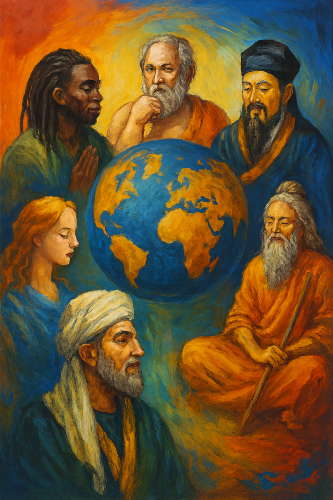
Today we live in the beginnings of the 21st century . Probably this may have no specific meaning except as an advancement in history of human beings and a considerable advancement in science and technology. However, upon deep scrutiny one can easily find that the last decade of the 20th as well as the beginnings of the 21st centuries are marked with deep and essential transformations of humanity as a whole, on the scientific, social, cultural, and philosophical levels. These essential transformations make it legitimate to depict this period as a completely new phase of humanity. If the previous phase of modernism, as well known, is characterized by what is referred to by Euro-centrism, then this new phase in which we are just entering can be rightly characterized by its most essential and effective symptom, multiculturalism. Hence, we are now, at the beginnings of the 21st century, in a state of 'Multi-Cultural Modernity'.
This new state of humanity is a culmination of three well known states that formulated a transition period, namely 'Post-Modernism', 'Post-Colonialism' and 'Globalization'. In today's world although Western civilization is till dominant, admission of differences and varieties and uniqueness of contemporary main human cultures is granted. Consequently, differences of 'worldviews', ways of living, systems of values and beliefs, are generally acknowledged. This acknowledgement exerts a great effect on every aspect of contemporary human civilization, from our understanding of science and technology and its role in advancement of humanity to our understanding of the differences in our social as well as political systems, and to our understanding of the meaning of being one universal human society that is comprised of several unique cultures.
Multiculturalism can be understood both negatively and positively. In its negative sense, cultures are separated, isolated and in a state of endeavor for mutual extinction. In its positive sense, cultures comprise a medium of human thought fertility through its diversity in 'Worldviews', and in a state of positive competence toward creativity and advancement of humanity toward new horizons. <
It is no doubt that we adopt this second positive position, not on a utopian sentimental ground, but on a realistic and rational ground. For what we understand from such a position is that it adds a burden of success of competence in advancement of different aspects of human knowledge on all contemporary major cultures. Hence, if contemporary Western culture is continuing its way in domination of scientific as well as philosophical thought, other major cultures, such as Chinese, Indian, African, as well as Arab/Islamic culture, are confronted of a difficult task of proving its competency in the process of advancement of such knowledge. For, scientists, philosophers, specialists and so forth of such cultures bear responsibility toward humanity to positively engage and participate in contemporary human thought and contemporary human civilization.
This positive participation mandates openness toward contemporary advancement in scientific and philosophical thought, assimilation of such advancement, and finally introduction of authentic new views to such advancements. The Arab/Islamic culture, is naturally, one of the major cultures of humanity, and hence, is required to undertake its share of participation of contemporary human thought and civilization, through these three basic features of participation, openness, assimilation and creativity.
An essential channel of intercultural communication is, certainly, cyberspace. We, 'Philosophers of the Arabs', through this site are making our endeavor to help to fulfill such requirements as a step toward a complete and positive participation of contemporary Arab/Islamic culture. Hence, We endeavor to achieve such a goal through supplying scholars with academic knowledge about contemporary philosophical activities in major cultures, especially underepresented philosophies.